

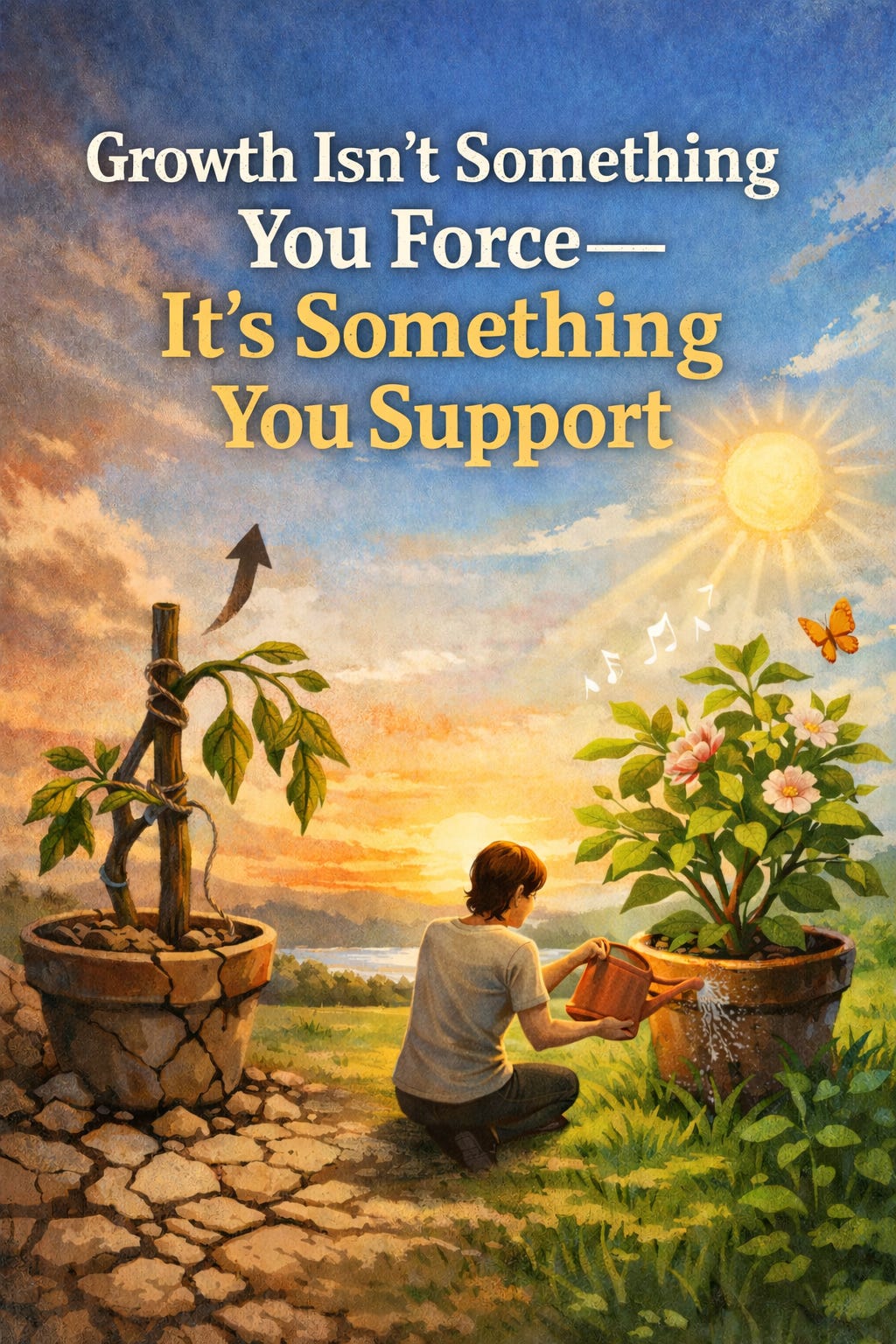
Growth Isn’t Something You Force—It’s Something You Support
We tend to think of growth as effort.

As something that happens when we push harder, try more, and refuse to stop.
But that model of growth is incomplete.
There is another way to understand it.
One that is quieter, more sustainable, and ultimately more effective.
The Sanskrit word vṛddhikara points to this understanding:
Growth that is supported.
Not forced.
Not rushed.
Not extracted.
When we examine how growth actually occurs—whether in the body, in relationships, or in systems—we begin to see a pattern.
Growth depends on conditions.
A plant does not grow because it is commanded to.
It grows because it has access to light, water, and space.
Remove those supports, and growth becomes difficult—if not impossible.
The same is true for us.
When we attempt to force growth, we often override the very signals that would guide us toward sustainable change.
We ignore fatigue.
We push through resistance.
We attempt to accelerate processes that require time.
The result is not true growth.
It is strain.
Strain may produce short-term results.
But it is rarely sustainable.
Support, on the other hand, creates the conditions for lasting change.
Support looks like:
Consistency instead of intensity.
Rest instead of depletion.
Connection instead of isolation.
It also requires a shift in how we relate to abundance.
If growth is supported through connection, then abundance cannot be understood as accumulation.
It must be understood as participation.
Abundance is not something we possess.
It is something we are part of.
It exists in the relationships between things.
This understanding challenges one of the most deeply held assumptions in our culture:
That there is not enough.
Scarcity encourages force.
It tells us to take, to secure, to control.
It frames growth as a competition.
But when we move into participation, that dynamic changes.
Growth is no longer something to win.
It becomes something to support.
This does not mean that growth is passive.
It requires attention.
It requires care.
It requires the willingness to remain present with what is unfolding.
But it does not require force.
The question, then, is not how to grow faster.
It is how to create the conditions where growth can occur naturally.
Where are you forcing?
And where could you begin supporting instead?
Because growth is already happening.
The only shift is how you choose to meet it.